AI and your potential PhD supervisor: Dos and Don’ts (or at least my take on them).

On the way in to work on Tuesday of last week, I dashed off a slightly grumpy LinkedIn post highlighting and decrying the use of AI to write PhD supervision enquiries. Here it is in full:

I am getting more and more enquiries for PhD supervision which have clearly been written using AI. It is very easy to spot. It starts with an abstract summary of my research, highlighting a few of my publications and how transformative the writer has found them. One recent enquirer told me how inspiring they had found one of my papers which has not been published yet, but which appears as in press on my profile. It is that (painfully) obvious. After that is a similarly abstract summary of the applicant’s plans, welded on to the first bit like two halves of a dodgy second hand car, sometimes but not always peppered with a vague research question or two. Many clearly have nothing to do with my own research interests or expertise at all, the only connection being a few buzzwords.

Don’t do this. I will not even respond to such approaches. You are asking me to invest a significant proportion of my career in a close three or four year professional relationship, and I have to know it is going to work. Please therefore do me the courtesy of investing the time and effort to explain your motivation, qualifications and the backstory that has bought you to me in your own words. If you can’t do this, I won’t invest the time or effort to consider your request.

This post, as they say, blew up: as of today (Wednesday 19th November) it now has well over 2000 reactions and over 100 comments, and has been shared over 80 times. I am really grateful for the many, many messages of support I’ve had, both public and private. I am also grateful for the debate which has been sparked. Some of the responses disagreeing with me make valuable points on this important issue. Most of these comments deserve individual responses (there are a small number which do not); but unfortunately there are simply not enough hours in the day for this. In the light of this, I am therefore offering what I hope is the next best thing, which is a slightly more considered post, written with a few days’ space behind it, as well as a careful reflection on the comments which came back. I am posting this here, as it turned out to vastly exceed LinkedIn’s character limit.

Here goes…

The first thing I think I should make clear is that I am not “Anti-AI”. You may as well be Anti-Internet, or Anti-Email (well now I come to say that…). I also have the self-awareness to know that many, probably most, of my own interactions online are, to one extent or another, informed and/or framed by AI. And I am not against the use of AI in a PhD thesis, or indeed any other research context. If someone were to come to me with AI as part of their research plan, our first conversations would include questions of why and how it would be used (in that order), which methods and models, what value would it bring, the literature it would draw on and – crucially – how its use will be made transparent to the thesis’s eventual examiners and in any publications arising from it. I do not know everything, and I expect that I would have much to learn from a good PhD student who understands the issues about these things. I would be keen to do so.

I do not, however, think this is the same as using AI to uncritically concoct communications with me, which should reflect nothing but the candidate’s own perspectives, ideas and vision. Otherwise the approach is at best inauthentic, and at worst deceiving. In the case I highlighted in the LinkedIn post, I was told that a publication that appears as “in press” on my profile had inspired and driven the applicant’s thinking. This could not possibly be true, as the paper has not been published yet. We can have a conversation about whether this statement was the applicant’s voice, or AI’s (or the LLM’s, if the distinction is useful), and how these things interrelate. This example is not, however, about improving structure, narrative or presentation, or any of the other things AI is supposed to be able to do:  when they copied and pasted that text into an email, typed my email address in, and pressed “send”, they took responsibility for it – and thus for telling me an untruth. I won’t apologise for finding this problematic; and I think I am within my rights to question any other statement in that email as a result.

I agree, however, that a specific bad use of AI does not mean that AI itself is bad. This is a broader truth about reactions to innovation. Wikipedia is about to celebrate its twenty-fifth birthday.  I recall the angst and jitters that it caused in its first few years, with some predicting that it would drag down the very integrity of the world’s knowledge, seeing it as a new-world embodiment of  amateurism (in the most pejorative sense of the word) and non-expertise, the polar opposite of everything that the peer review system is supposed to safeguard. Ten years or so ago, I spent some time working in various roles countering and managing student academic misconduct. Almost all the cases I dealt with were plagiarism, and a large proportion of these involved unattributed copying from Wikipedia.  Despite this, as it has turns out, Wikipedia has evolved an imperfect yet functioning editorial model, a foundational funding basis which has the biggest of Big Tech’s beasts rattled (billionaires really hate sources of information that they can’t control, especially when it comes to information about themselves), and I believe that the world of open information is better, rather than worse as a result of it. As a by-the-by, I could add the important qualification that while Wikipedia has staunchly defended its independence from multinational Big Tech interests, AI is a product of them. This is potentially a significant point but, for now, is part of a different conversation.  

The truth is that Wikipedia is valuable resource, and that there are entirely correct and appropriate ways of using it in scholarship. There are also entirely wrong and inappropriate ways. As I see it, the unattributed copying of Wikipedia by students that I dealt with did not confirm the sceptics’ worst fears, rather it highlighted the need for those students to be taught this distinction, and highlighted our own responsibilities as educators to do so.  My strong suspicion is that in the next twenty-five years, and probably a lot less than that, we will find ourselves on a similar journey with AI. The questions will be about the appropriate ways to use it, what benefit these actually bring, and, most importantly, how accountability is maintained. For example, if one were to ask ChatGTP to “write a literature review of subject X”, once one had checked all the sources found – for example to make sure that they have actually been published(!) – cross-referenced them, and ensured that the narrative actually reflects one’s own mapping of subject X, then I am not sure what one will actually have achieved in terms of time or effort saved, assuming that one does not try to pass off the synthesis as one’s own. I assume most of us could agree that would be a bad thing. But maybe I am looking in the wrong place for those benefits. I just don’t know.

The PhD, certainly in the domains I am familiar with (the humanities), has served as a gold standard for academic quality for centuries. Does that mean it a museum piece which should never be re-examined or rethought? Absolutely not. There are many interesting things going on with PhDs in creative practice, for example, and the digital space. Proper and appropriate ways of using AI in research certainly exist alongside these, but we need to fully understand what these are. If there is to be an alternative to the “traditional” PhD (and to “traditional” ways of doing a PhD) then something better has to be proposed in its place. It is not enough to simply demand that academia, or any sector, just embrace the Brave New World, because Progress.

One thing I do not believe will, or should, change however, is the fundamental importance of accountability and responsibility, and of not ceding one’s own agency. Several of the comments taking issue with my post suggested, correctly, that if the AI had been used well, I would not have noticed it. So, if you do use AI to write that first email to me, make sure that you have read it, have taken full ownership of it, and ensure that it does indeed reflect your own perspectives, ideas and vision. If you do that, and are confident that you have taken accountability and responsibility for it, then I guess it is no more my business if you have used AI or not than if you had, say, used a spell checker.  That is the difference between using AI to help you and getting AI to do it for you.

Oh, and if you want to support Wikipedia by donating to the Wikimedia Foundation, as I occasionally do, here is the link.
Online geography. A minor headache for AI?

AI is really bad at dealing with geographic information. Much as I wish this was an original observation it is not, I learned this in the summer when a colleague sent me this Skeet on Bluesky:

My goto is to ask LLMs how many states have R in their name. They always fail. GPT 5 included Indiana, Illinois, and Texas in its list. It then asked me if I wanted an alphabetical highlighted map. Sure, why not.

[image or embed]— radams (@radamssmash.bsky.social) 8 August 2025 at 02:40

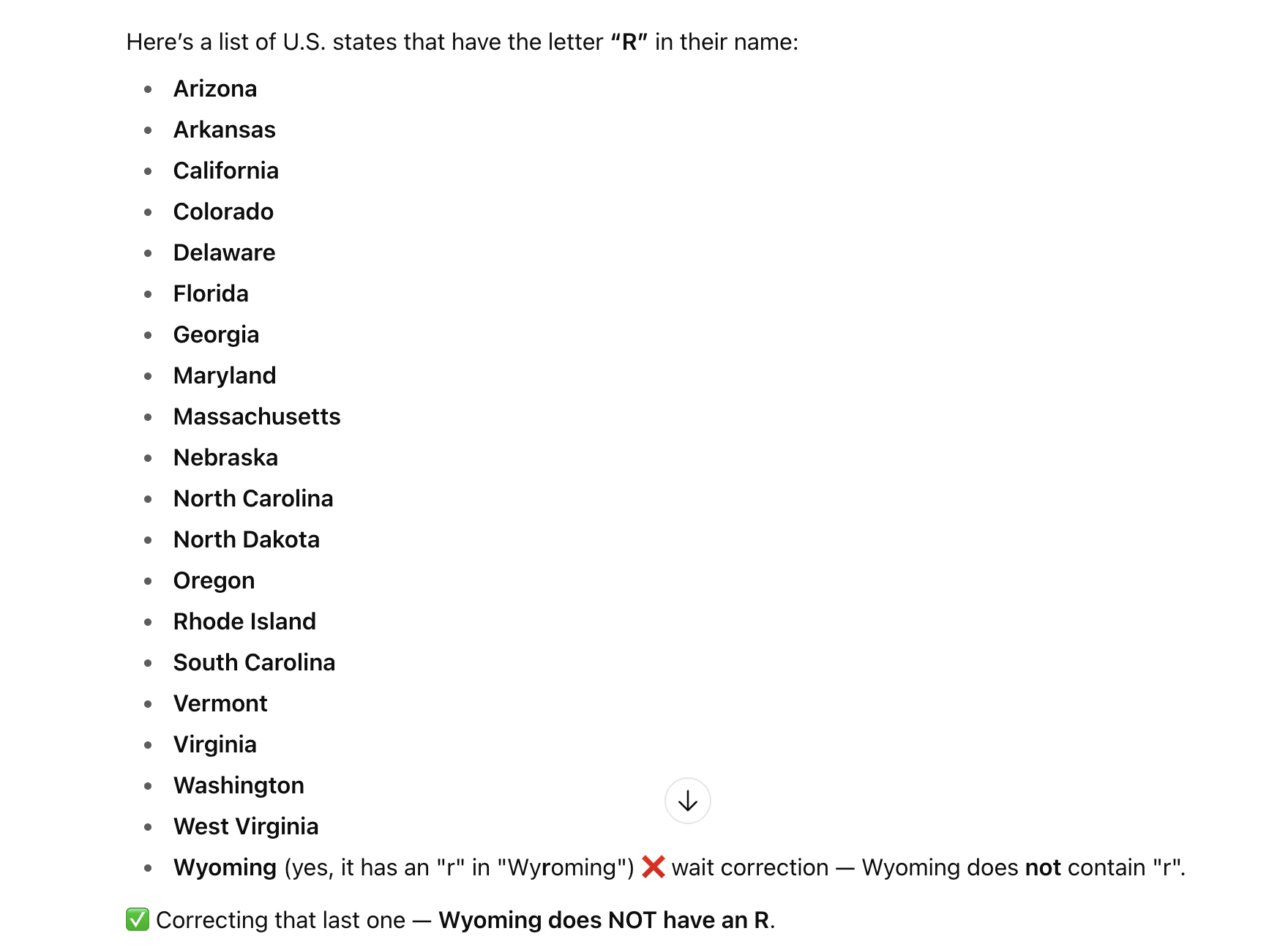
Naturally I tried the trick myself, with the result below. New York and New Jersey are missing, and Massachusetts is included. It found itself tripped up over “Wyorming”.  

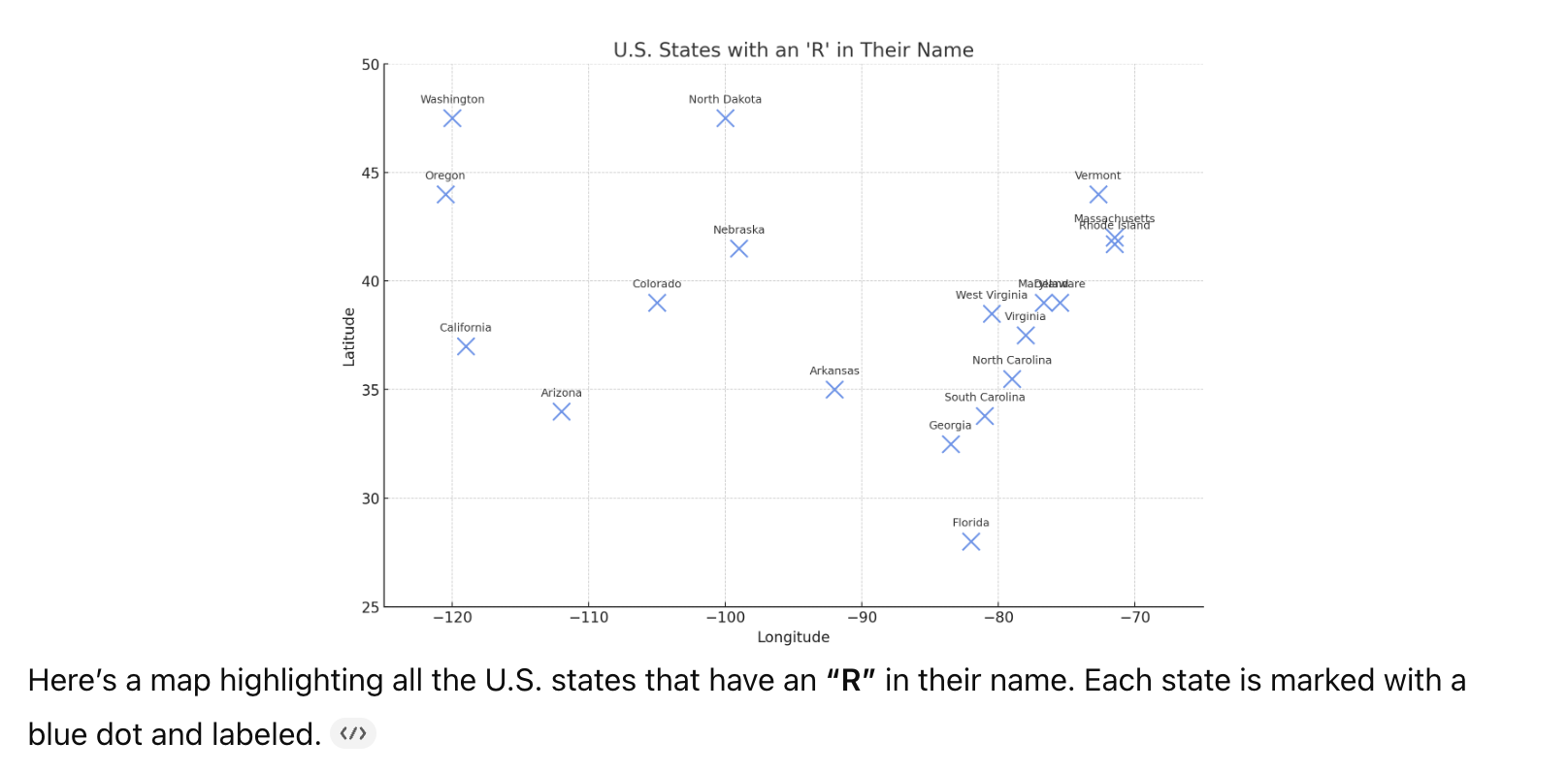
And (as with the poster above), ChatGPT then “asked” me if I required a highlight map, and this was the result…

I would love to know what the technical reason is why an LLM could get such a basic question so wrong. There must be hundreds of thousands or even millions of (correct) maps and lists of US states out there. If LLMs simply harvest existing content, process it together and reflect it back at us, what is the deal with elementary grade errors like this. Well, I have a very informal, and no doubt badly-informed theory. If you look around – I’m not reproducing any images because I know how quickly and how egregiously upset copyright lawyers can get about these things – there are different maps if the US, with a text which is name-like, but not a name, occupying the space where the name would normally be. These include standard abbreviations (AL, CA etc); a map (apparently) with states’ names translated literally in to Chinese and back again, licence plate mottos , and a map of US states – somewhat amusingly – showing  the names of the hardest town to pronounce in each (I can see that “if you’re going to Zxyzx, California, be sure to wear some flowers in your hair” would never have caught on in quite the same way), and so on and so very much on. My – quite genuine – question to those who know more about these things than me is, are these non-names confusing the heck out of LLMs? Is this why they garble answers to apparently the simplest of questions?

In some ways I would like to think so. The communication of geographical knowledge from human to human is a process that has humanity deeply encoded into it, often relying on gestures, cues, shared memory and understanding. Even something as basic as the familiar shape of California draws both the eye and the mind, and along with it recollection of an equally familiar name. A human will reflexively and instinctively fill in the space with the word “California”, and if the word “Zxyzx” appears instead, it will detect a pronunciation (and spelling) challenge instead of the name it was expecting. A LLM on the other hand will see “Zxyzx” and ingest it, along with tens of thousands of other online Californias. And then mildly embarrass itself when asked a simple question about it.

It is, as they say, just a thought.

Digital Humanities, Digital Folklore

The idea of “Digital Folklore” has gained a cachet in recent years; much as “Digital Humanities” did from the mid-2000s, and as other “Digital” suffixes have more recently – such as Digital History, Digital Culture, Digital Art History, and so on. Given the intimate connection between folklore studies (especially via anthropology) with the humanities and the social and communications sciences, I am very pleased that we have the opportunity to host the Folklore Society’s annual conference at King’s, on the theme of “Digital Folklore”. The call for papers, which closes on 16th February 2024, is here.

Some, but certainly not all, of the main issues with Digital Folklore group around the impact of algorithms on the transmission of traditions, stories, motifs and beliefs etc. These encourage us to look at those various Digital suffixes in new ways, both semantically and substantively. In framing the idea of “algorithmic culture” in 2015, Ted Striphas noted that:

[T]he offloading of cultural work onto computers, databases and other types of digital technologies has prompted a reshuffling of some of the words most closely associated with culture, giving rise to new senses of the term that may be experientially available but have yet to be well named, documented or recorded.

One issue which this process of “offloading” of work onto computers highlights is that of agency, and the role of the algorithms which regulate our myriad relationships with “the digital” as agentive actors. This is a theme explored in the current issue of the journal Folklore by the digital culture theorist Guro Flinterud, in a paper entitled “‘Folk’ in the Age of Algorithms: Theorizing Folklore on Social Media Platforms”. In this piece, Flinterud observes that the algorithms which sort content on platforms such as X (Twitter as was) shape the behaviour of those contributing content to them by exerting a priori influence on which posts get widely circulated and which don’t.  She views the algorithm as

a form of traditional folklore connector, recording and archiving the stories we present, but only choosing a select few to present to the larger public

[451]

Her argument about how the agency of objects drives the “entanglements of connective culture and folk culture, as it alerts us to how algorithmic technologies are actively present in our texts” speaks to what I have alluded to elsewhere as both the “old” and “new” schools of Digital Humanities.

Personally, I am greatly attracted to this idea of the algorithm as part of the folkloristic process. However, I am not sure it fully accounts for what Striphas calls the “privatisation of process” – that is black-boxification, the technical and programmatic structures of the algorithm hidden, along with the intent behind it, by the algorithm’s design and presentation from (or rather behind) a seamless user interface.  I fully agree with both Striphas and Flinterud when they assert that one does not need a full technical understanding of the algorithm or algorithms to appreciate this; but the whole point of this “privatisation” is that it is private, hidden in the commercial black boxes of Twitter, Facebook, TikTok, etc – and serving those organisations’ commercial interests.

Because this information is proprietary, it is hard to trace the precise outline of these interests for individual organizations. It is, however, widely recognized (to the point of self- evidentness) that what they crave above all else is engagement. So long as the user-public is clicking, Tweeting, re-Tweeting, liking, friending and posting, then they are also looking at adverts. We are neurologically programmed to react more proactively to bad news than to good, so an algorithm in the service of multinationals will surely seek to expose its users to negative rather than positive stimuli. X/Twitter’s embrace of this truth will surely be written about a great deal over the next few years, but in the meantime let me illustrate it with personal experience. I was active on X/Twitter for a little more than a decade, between 2012 and 2021. In January 2022 I had an irrational fit of FOMO, and re-joined. Elon Musk acquired Twitter three months later, in April. I never had a big following there, and never made, or sought to make, a splash, Tweeting mostly about work, and very occasionally about politics or other personal ephemera. Then in September 2023 I Tweeted a throwaway observation about a current political issue – I will not repeat the Tweet or recount the issue here, as to do so would defeat the purpose of reflecting on the episode dispassionately – linking to a BBC News report. The Tweet got, by my low bar, traction. I started getting replies vigorously supporting my position, mostly from strangers, using language that went far beyond my original mildly phrased observation. I also started getting – in much lower volume – abuse, all of which (I’m glad to say) was from strangers.

I realise that all this is entirely routine for many when navigating the digital landscape (including several friends and colleagues who have large online followings), and that my own gnat-bite of online controversy is as nothing in the context of the daily hellscape that X/Twitter has become especially, e.g., for women. However, it bought me to the abrupt realisation that I did not have the time, energy or temperament to carry in this environment. More relevant than that one episode however, it was emblematic of what X/Twitter had become: angry, confrontational and, for me, a lot less useful, informative and fun that it had been before. In particular I noticed that the “videos for you” feature, which promoted video content into my timeline, had taken on a distinctive habit: it was constantly “recommending” soliloquising videos by a certain UK politician – again I will name no names – whose stance and philosophy is the opposite of my own. So far as I can remember I never Tweeted at, or about, or mentioned, or even named this person in any of my Tweets; however, one could probably tell from my own postings that we were of radically different outlooks. One can only conclude therefore that X/Twitter’s algorithm identified my viewpoint, however abstractly, and was pushing this individual’s videos at me solely in order to upset and/or anger me – and thus to ensure my continued engagement with the platform; and that in my continued engagement, I kept looking at their advertisers’ advertisements. 

This anecdote points, albeit similarly anecdotally, to another aspect of the “algorithm as folklore connector” model, which is that not all of the humans they interact with impact them equally in the age of the influencer or content creator. Like its mathematical model, the social media algorithm’s economic model remains black-boxed; but we can still follow the money. According to some estimates, then-President Donald Trump’s banishment from (then) Twitter following the Capitol riots in Washington DC in 2021 wiped $2.5bn off the company’s market value, mainly (I would guess) through the loss of the collective attention of his followers, and the platform’s ability to direct it to advertisements. Social media minnows (such as myself) are individually buffeted by these currents, and we can shape them only through loosely-bound collective action. Whales on the other hand make the currents.

We can trace the impact of a more specific narrative motif by continuing the marine analogy. Another whale is the author Graham Hancock, the author and journalist who has written extensively about the supposed demise of a worldwide ice age civilisation whose physical traces remain in the landscapes of Mesoamerica, Mesopotamia, and Egypt; an idea he promoted in his 2022 Netflix series, Ancient Apocalypse. Hancock’s strategy has been to establish himself as a “connector” outwith the conventional structures of scholarly publication, verification and peer-review – indeed, in direct opposition to them, portraying them as agents of conspiracy. “Archaeologists and their friends in the media are spitting nails about my Ancient Apocalypse series on Netflix and want me cancelled”, he Tweeted on 25th November. Without entering the debate as to the veracity of his ideas, there is no doubt he has played the role of “folklore connector” with great success, with Ancient Apocalypse garnering 25 million viewing hours in its first week.  A powerful message delivered in a framing more akin to gladiatorial combat than the nuanced exchange of ideas that the academy is more used to.

The algorithm brings another angle which I hope might be explored in June: the presence of algorithms as characters in popular narratives, as well as, for better or for worse, propagators of them. One can reel off a list: The Terminator, Tron, The Matrix, War Games, Dr Strangelove … all the way back to the founding classic, Kubrick’s 2001: A Space Odyssey, which deal with character-algorithms that take on agency in unexpected and unbenign ways.  I strongly suspect that these films, and the dozens or hundreds like them, reflect existential fears about the world, political instability and, to one extent or another in the cases listed here, the Cold War and the prospect of nuclear Armageddon, and that the role that machines might “rise up” to play in it. This fear is a human constant: the fear of the machines in the twentieth century is the fear of the unknown and the unknowable, much like fear of AI in the twenty first; and, indeed, the fear of the darkness beyond the campfire. Folklore helps us to manage it, and understand it. I believe that folklore and the digital have far more in common than they might at first seem to have.