Learning to doubt: signing off as HoD

Today marks the end of the four … interesting … years of my time as Head of the Department (HoD) of Digital Humanities at King’s College London. In a a College-wide briefing to HoDs last year, the Principal, Professor Shitij Kapur, described HoDs as “the line in the institution where the PowerPoints, the policy papers, the spreadsheets become the actions which make people’s lives better or worse”. I felt at the time that this description hit the nail on the head, and it has thus stuck with me. So: this is not another “reflecting on what is Digital Humanities” post (as I recently did for Viewfinder magazine), or an overview of my subject’s direction of travel (as I recently tried to offer in my Inaugural Lecture); rather I am going celebrate today by capturing a few insights into what I (think I) have learned by being part of the line.

Firstly, in general I have come to dislike the term “leadership role” in an academic setting. “Taking on a leadership role” sounds rather box-ticky, something you do for the CV, or for the probation or promotion panel. “Service” is slightly better, with connotations of facilitating actions for the greater good of a bigger whole in a way that “leadership role” doesn’t. “Citizenship” I think is a bit too generic. “Leadership role” still sets itself apart from the main business of working life. At risk of sounding cliched and/or trite, the aim of a “leadership role”, however flawed the term might be, should be to make life better for all and, by expecting high standards of it, oneself and others, to elevate the institution as a whole.

So far, so worthy. Having got that out however, I am not so overrefined as to claim this is why I put myself forward for the job in summer of 2019 (although it is something I have come to realise, and judge myself on, in the meantime). Rather, in 2019, DDH was still in the throes of rapid and turbulent expansion in both student and staff numbers, some of it planned, some of it unplanned.  I guess I felt that all the components of a vibrant, exciting Digital Humanities research agenda were there, one which was distinct from the kinds of DH done elsewhere, yet which had evolved and grown from twenty or more years of DH teaching and research at King’s. We could, I told myself, create the twenty first century successor to a long tradition of digital scholarship in, for and about the humanities. However, the whirlwind of constant expansion was stopping us from putting it all together. With several great opportunities and specific problems to address, it therefore seemed an exciting time to take on the role. In February 2020, shortly before becoming busy with other things, I published a post on here marking my first six months as HoD. In this, I argued that

DDH’s story is one of evolution, development, and even – perhaps contrary to some appearances – continuity. This is an impression driven by the kind of question that we have always asked at King’s … The prepositions “with” and “about” [the Digital, our strapline] provide space for a multivocal approach, which includes both the work DDH(/CCH) has excelled at in the past, and that which it does now.

Life, however, gets in the way of the very best plans. I became, of course, a “Covid era HoD”, and like many, my time became defined by the pandemic. During those first months of 2020, I remember learning, quickly, how to take one day, and one piece of information, at a time, and how try not to participate in cascades of dodgy information, whether from inside or outside.  I vividly remember that I learned about our first Covid case in the Department’s student body on Thursday 12th March 2020 at exactly 5.45 PM, 15 minutes before I was due to take the lectern to give a Gresham College lecture, which itself turned out to be the last in its series before lockdown came.  Heady days indeed. Most, but not all, of our classroom teaching had finished by late March 2020, but we still had to adapt, or “pivot” as the term came to be very quickly. We found ourselves working in ways I certainly didn’t expect, having to form a small, agile, very centralised management team that could respond quickly to events that changed almost by the hour through the spring and summer.  As a Department with many international postgraduate students, we were particularly exposed to the risks of lockdowns and travel bans. However, the launch of our new MSc in Digital Economy in September 2020 was a major success; and our “pivot” to online, while of course turbulent, worked. Thanks to the innovation and creative flair of my colleagues across the Department, we came through.

Since 2019, we have made a large number of new permanent academic appointments (bearing in mind there are various ways of counting this apparently simple statistic which are too convoluted to go into here, so I am not even going to try). Our professoriate has tripled from two to six, achieving 50/50 gender parity in the process. In the Department, a responsive and discursive research agenda is emerging. We have had considerable grant success, with a cumulative income well into the seven figures, since 2021. Most importantly though, we have seen the emergence of a set of interoperating research clusters in the Department: in Computational Humanities, Creative AI, Environmental Humanities, Global Digital Cultures, and the Centre for Digital Culture, which has now become an integral part of our Faculty’s new Digital Futures Institute. There is much, much work still to do: a year plus after returning to fully in-person teaching, steps are needed to build our research culture, especially with so many new colleagues. This will take time. The question which is always implicit in these conversations is how much time?

But “satisfaction”, whatever that is, remains elusive. This is not in any way a criticism of anyone, rather it is a manifestation of a bigger truth: like the black and white geese in the M. C. Escher image, a Department is two things at the same time. It is part of a larger institutional and intellectual ecosystem which fosters it, provides it with infrastructure, gives it an official and reputational home, shields it from occasional meteor strikes which would otherwise cause it (and its HoD) devastation, and expects things in return. It is simultaneously a community of scholars, a key part of whose job it is to be independent-minded, with a natural desire to question, to self-govern, and an inclination – indeed a responsibility – to develop a collective research agenda into which all can buy. And they also expect things in return.  The purpose of the HoD is to enable their Department to exist in these two parallel states at the same time and – as much as possible – to maintain an equilibrium between them.  The whole edifice exists in a state of constant negotiation and renegotiation. It is a journey with (hopefully) direction, but no final destination.

Being in a Department which has expanded so much and so quickly in the last decade has also brought some larger truths about Higher Education up close and personal. It is probably not too controversial to say that the national funding model, and the principles behind it, are no longer fit for purpose. Across the UK workloads are out of control, people are stretched, compromise become inevitable in areas where we would rather not compromise, and there is often a sense of “running to stay still”. This makes maintaining the equilibrium between the Escher geese harder and harder, and occupying the “line” in the institution as described by Prof Kapur, gives one a very clear perspective on this. My own two cents is that the traditional residential three year BA/one year Masters is certainly a gold standard for the humanities which must be jealously guarded. However, the idea that this one the one model is the best or only one for everyone belongs to an era – which, sadly I am old enough to remember – when an academic could know every student in a year cohort, or even a whole Department, by sight. This is why I am very glad that we have begun to experiment with professional education, career accelerators and short courses; smaller and more adaptable pedagogies of imparting our knowledge to those who need it in more flexible timeframes. Working in such an interdisciplinary field, and across so many disciplines, we have had to develop strong collaborative, pedagogical and method frameworks in our own research. Having worked on some of these experiments directly myself, I have come to believe that these frameworks are strong enough to be bought into the commercial and industry worlds without any compromising of academic standards or rigour. So maybe this points towards the future.

One of the achievements I am most proud of is instituting our King’s Public Lecture in Digital Humanities, a major new biennial platform for the field’s leading international scholars (which I am much looking forward to continuing to organize in 2025). It was inaugurated this May by the stellar Shannon Mattern, who tackled the issue of modelling doubt in the digital age. The ability to get to grips with doubt is unquestionably the most important skill I have learned. I thank all of those who have taught me this.
Inaugural Lecture, 20th June 2023

I was very happy to give my Professorial Inaugural Lecture at King’s on 20th June 2023. It was a truly memorable occasion: a true pleasure to air my obsessions to a wonderful audience of friends, colleagues and family.

The title was The Spatial Humanities: A Challenge to the All-Knowing Map. The full text, although not the images due to the weed-strewn tracks of copyright and other restrictions, is here.

The link to the video is here.

Thank you so much to all who attended in person or online.

Coffin Way, Oxfordshire

Another possible corpse path walked this week. “Possible”, because the evidence for it is both anecdotal and unsubtle – a footpath listed on local maps as “Coffin Way”, which runs south east/north west between the villages of Upton and Blewbury in South Oxfordshire. The chalky and flinty landscape of this region certainly has documented corpse path traditions – I have written elsewhere of our excursion along the nearby corpse path between Faringdon and Littleworth (although back in the pre-boundary changes day this was in Berkshire). A cursory online scratch revealed little about the history – a passing reference on a walking blog to a discussion about the name’s derivation and a reference on a French-language Wikipedia page on “Chemins de Mortes”, where are seemingly a pretty big deal in rural France.

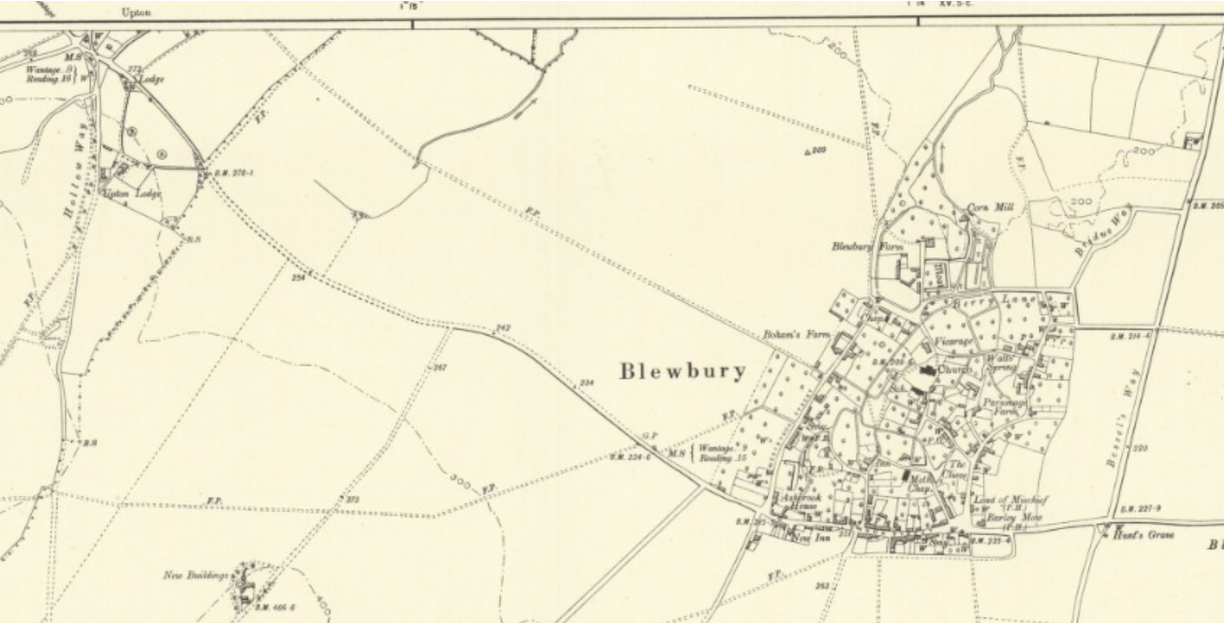
Berkshire Sheet XXI.NE
Revised: 1879 to 1898, Published: 1900


The path is marked but not, as is often the case, named, on the Second Edition Ordnance Survey map, which was first surveyed in 1876 and re-surveyed in 1897-8.  Interestingly, Upton and Blewbury both have ancient churches; the entrance to the former being framed by two particularly splendid yew trees which are clearly of very, very great antiquity. If “Coffin Way” was indeed a coffin road therefore, one assumes that at some point one or other of the churches must not have had all-including burial rights.

Yew trees at the church at Upton

Coffin Way heading between fields

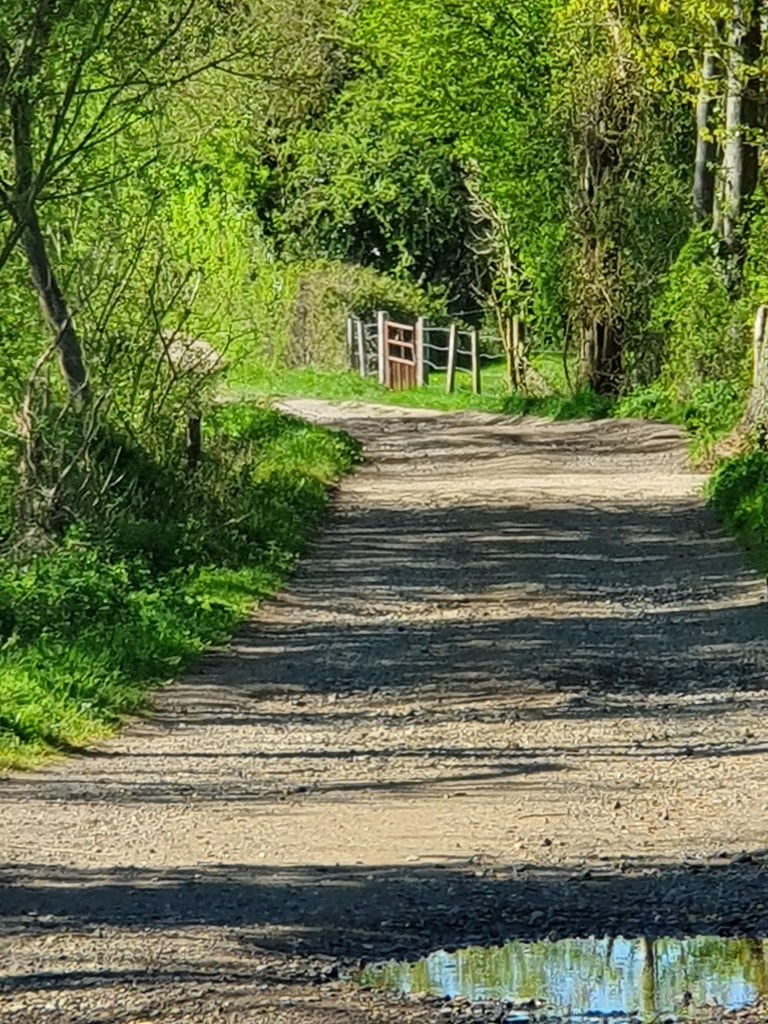
The path itself is a flat, pleasant and easy-going route, heading almost as the crow flies for a mile and a bit across the downland. Away to the north, the Iron Age splendour of Blewbuton Hill rises up, as the path sweeps between fields of rape seed and beans. As at Farringdon, for most of the stretch, there is no other physical boundary between the fields – the footpath insinuates itself through the landscape like an invisible tree root.


Outside Blewbury itself the route makes its way between two hawthorn hedgerows, whose full effect we got in the April sunshine. Echoing the documented path at Farringdon, the field-hugging way seems to become more formalised and delimited, possibly as a result of “bier balking”, as it approaches the outskirts of the village. Thick branches and roots at the foot of the hedgerows suggest they are at least as old as the pathway shown on the OS map. On the way back, we stopped to watch larks, which were indeed ascending, at the fringes of the route.

Hawthorn hedgerows outside Blewbury

So: while the historical evidence is scanty, this is if nothing else a path with strong historical associations in the landscape, and an interesting name. What’s not to love?

Movement: a review, reflections

Having done it for 17 years, I know that commuting into Central London is taxing process. Taxing in terms of money certainly, but also in terms of time, physical and mental energy, often productivity and stress. As I live about 40 miles west of the capital, this involves a bus and a train, and then a Tube journey from Paddington to my office, a journey of a bit over one and half hours if it goes well. It was partly this, and partly my academic interests in thoroughfares and mobility, which led me to read Movement: how to take back our streets and transform our lives(2022), by Thalia Verkade, a Rotterdam-based journalist, and Marco te Brömmelstroet, a social scientist and expert in urban planning at the University of Amsterdam, who has a large Twitter following as “The Cycling Professor”.

In Movement, this collaboration has produced a lively and radical piece of research-driven investigative journalism which seeks to ask “why has traffic taken over our public space?” Traffic, and especially vehicular traffic, has become such an integral part of life that we don’t stop to question why this is, or indeed why it should be. A sign which declares that a road is “closed” for a street party is closed to cars, but open to people; yet the language of “road closure” is do obvious that it blends in. This bias in language reflects historical trends: we have become vastly more mobile since 1950, but while distances travelled have increased, the time we spend travelling remains broadly the same (this is Marchetti’s Constant). If a mode of travel comes along which cuts the time it takes from home to work by 25% then, in the long run, we do not spend less time travelling, we get either a better job or a better house, and the travel time remains the same. It is also for this reason that simply increasing capacity of the transport network will never solve the problem of congestion: make a six-lane motorway into an eight-lane motorway, and you will not reduce the density of traffic, you will increase the volume of traffic. This is the law of economic gravity in action.

Many of the book’s key insights are framed as Direct Message exchanges between Verkade and te Brömmelstroet, with the former framing questions and developing the narrative in a journalistic way, and latter providing scholarship-driven perspectives. This sets a lively, conversational tone in which the book’s main argument is conveyed. It is remarked, for example, by te Brömmelstroet that the “pain of half a century of spatial planning” has stemmed from an assumption that the prerequisite for a better quality of life and escape from the rat race is the ability to travel further, faster, more comfortably and more cheaply, in response to Verkade’s observation that changing the status quo is painful. The implied opposite of this is what do we do to improve the spaces in front of us. The discursive narrative between the two convincingly establishes the former as a neoliberal myth, into which various powerful interests have become heavily invested. Interestingly, this includes in some cases organisations which are supposedly committed to furthering the interests of the passenger/pedestrian.

The central plank of Verkade and te Brömmelstroet’s thesis is that “car logic has colonized our thinking” to the extent that it becomes difficult to imagine roads or routeways as anything other than dangerous areas to be navigated with the most extreme care, and where the motorcar has unquestioned right of way. Verkade presents three images of the junction between Benthuizerstraat and Bergweg near her home in Rotterdam, from 1908, 1932 and 2020. The change is certainly striking: the scene in the first image is, in Verkade’s words “like a village … [t]hese streets weren’t through roads: this was an area where people strolled about.” The same scene depicted in 2020 is now “one of Rotterdam’s most dangerous junctions”. The evidence amassed for car-colonization is certainly compelling, and its consequences sobering. In general terms at least, the idea that the car has colonized our way of seeing mobility; and realising this critically is a point of epiphany.


A key question which the book touches on throughout, but which I felt never entirely answers, is how the idea of car-colonization really extends to different regions, cities cultures and countries. Writing this reflection from the perspective of one who works (but does not live) in London, this meta-question raises further issues. Few would argue that the coming of the automobile in London was over decades, and remains, a badly negotiated hotchpotch of compromise, conflict and congestion, as an ever increasing volume of traffic elbowed its way along centuries-old streets and between ancient buildings. I get a reminder of this whenever I go into work. Near my office there is a junction linking Waterloo Bridge with the Strand and Aldwych, which is a rather terrifying spaghetti junction of cycle lanes, bus lanes, carriageways, pedestrian crossing and pavement. One is frequently reminded that one moment of lapsed concentration (or road rage) by a cyclist, pedestrian or motorist could have dire consequences (see pic below).

(Spaghetti) junction of different road use types at the Strand/Waterloo Bridge intersection

The car may also have colonized our thinking on London, but I suspect it has probably met more colonial resistance here than in other places. The iconic place of the London Underground in London life, and in London’s genus loci, underlines to this. Witness, for example, the reaction when the authorities tried to remove the Thames from the Tube map in 2009. Contrast on the other side the grid plan layout of many US cities, with their all-sweeping angular logic designed clearly with the car in mind (see Deidre Mask’s wonderful The Address Book: What Street Addresses Reveal about Identity, Race, Wealth and Power (2020) for a discussion of this). It is perhaps also the genus loci of London, and the UK’s other ancient cities, that efforts to negotiate better, or at least more progressive relationships between the car and the public space have riled conspiracy theorists linked to climate change denial, and other “globalist” themes. Current plans by the London administration to expand the city’s Ultra-Low Emission Zone (ULEZ) for example, which have the aim of removing older, polluting vehicles from the city centre, have met with objections that it is “a grand conspiracy to take away … freedoms through mass surveillance and enforced fines” (although there are more mainstream concerns raised by unions about the ability of low to medium paid workers being able to get to work). Similarly, the notion of the “15-minute city”, where residents like within fifteen cycle or walk from all the amenities they will need, has been described as “an international socialist conspiracy”, and led to unruly protests on Oxford. The 15-minute city is, apparently, a plot to constrain us within pre-defined geographical areas, and to shadow our footsteps with automatic cameras if we seek to leave them.



The glimpse of an alternative has recently emerged, again in the neighbourhood of my own workplace. Westminster City Council’s Strand/Aldwych pedestrianisation project has seen vehicular traffic routed round Aldwych to the north, closing our section of the Strand to traffic and opening it to pedestrians (and cyclists) – see picutures. The result is wonderful – a clean-feeling open space, framed by the spires of St Mary le Strand and St Clement Danes. The ability to traverse the space gives a greater feeling of open skies. It is a space where you can sit, socialize, eat lunch, or just wander (and, in my case, sketch sometimes). It is clearly not a solution to improve the through-flow of traffic in the city; but what it might do as the project progresses is promote “flow”, as described in Movement, the state in which you think, feel and exist more freely, “that blissful feeling people can experience when al their attention is in the moment, often leading to flashes of inspiration”.

The pedestrianised Strand in the sunshine /1

Movement was also grist to my own research, into historic vernacular thoroughfares and routeways. The archaeologists Jim Leary and Martin Bell pointed out in 2020 that much historical and archaeological research into routeways was hamstrung by a residual suspicion that it is a topic of pseudoscience and pseudoarchaeology, stemming from Alfred Watkins’s enormously influential but methodologically flawed Old Straight Track (1925). I believe we can add Verkade and Te Brömmelstroet’s analysis of car-colonization to this as a reason for limiting our scholarly imagination about the history of routeways, and our assumption that they are passive conduits, whereas they exert massive proactive influence of our lives, culture and history.

The pedestrianised Strand in the sunshine /2

In summary, Movement is a work of activism, public scholarship and journalism that I found hugely energetic and energising. It is a book which deserves to be read by anyone who cares urban citizenship, the public spaces in which it happens, and the history and culture that those spaces encode.

The Dainu Skapis: a window on to Latvian folklore


It is always a privilege to be given a special insight into a country’s cultural heritage, and such a privilege came last week on a brief visit to Riga, which included a talk on digital public spaces at the National Library of Latvia. This imposing building itself draws inspiration from folklore, being modelled on the mythical “Palace of Light”, a motif for wisdom that has been lost and reclaimed through triumph over adversity; a theme very much in tune with Latvia’s national identity. After the talk, I was fortunate to be given a tour of the Archives of Latvian Folklore of the Institute of Literature, Folklore and Art (University of Latvia), which is located in the National Library, by colleagues Sanita Reinsone and Ginta Pērle-Sīle.

The National Library of Latvia, “Palace of Light”



At the centre of the archive is the Dainu skapis, or “cabinet of folksongs”. This remarkable, purpose built edifice was constructed according to the design of Krišjānis Barons (1894-1915), a foundational figure in the study of Latvian folklore, who collected the archive together and edited the collection into its structured form. It consists of over 260000 paper slips which document folksongs, each of no more than four lines or so, which provide commentary on every aspect of daily existence. Through this lens can be seen a rich and powerful picture of rural life, its joys, heartbreaks and milestones, and the very powerful connection which many Latvians have to their home region.

The Dainu Skapis

Detail

The Dainu skapis gives us an insight into the methodology of folklore. It was by a happy chance at the turn of the twentieth century that the process of recording the folksongs in text, which enabled their preservation and ongoing availability in the archive. This further cemented their place as a core element of Latvian identity and heritage, and sustained it through the immense geopolitical challenges that the Baltic region faced in the nineteenth and twentieth centuries.

On my visit, I heard about the Archive’s exciting programme to digitise the Dainu skapis, which is available here. Many of the folksongs have been transcribed and are now available online. Scrolling thorough these often-enigmatic little texts (even through the not always perfect lens of Google translate), they are strangely compelling. As with all the most interesting examples of the folklore of any culture, they shine a light into vernacular stories that come up from the land, and which are often missed by history’s more mainstream  voices.

(Im)precise illusions: past place and the understanding of digital place

I have just submitted the final proofs of a book chapter on the topic of “Spatializing the Humanities” to the forthcoming Bloomsbury Handbook to the Digital Humanities, edited by James O’Sullivan. This is an attempt to link the interpretive challenges of digitizing historical (or rather historically expressed) geodata such as maps or gazetteers, the kind of work which gazetteer initiatives such as the Pelagios Network has excelled, with contemporary theory on the interpretation of “born digital” geodata on, for example, Google Maps or OpenStreetMap. The submission of this chapter coincided with a keynote talk I gave recently (and virtually) at the Meaning in Translation: Illusion of Precision conference at Riga Technical University in Latvia. “Illusion of precision” captures perfectly the challenges of “translating” historical place to the digital world, so I thought it was worth capturing some of the links between the chapter and the keynote.

There are some common threads that run between  “heritage geotada” and “contemporary geodata” that are (or will be) worth exploring in the methodological frameworks of both history and archaeology (with which we explore place in the past); and science, technology and innovation studies, which has done so much to define place in the present. There are a number of links lurking between the surface between these areas as disciplines: they have more in common than one might think (this, by the way, gives me some hope in my oft-stated desire to integrate the Old and New schools of Digital Humanities in my home Department at King’s College London).

A great deal of archaeology, after all, is the story of technology in the longue durée: the supra-frameworks of Palaeolithic, Mesolithic, Neolithic, Bronze and Iron Ages is defined by the technological competences of fashioning lithic artefacts, and then of smelting naturally occurring ores into bronze and then iron. Whilst, for convenience, we often follow our nineteenth century forbears in conceptualising these as massive, monolithic (no pun intended) blocks of time extending neatly back into the human past, the discovery of the processes of making bronze and iron must have led to enormous social, cultural and economic upheaval, the creating and cementing of elites, the generation of wealth for some and poverty for others, the refashioning of whole societies – and as these societies were preliterate, we simply lack the documentary sources with which to see these events. However technology continues to have much the same sort of impact today, in the so-called Information Age. As my DDH colleague Jonathan Gray has written of “data work”: “[s]imilar moves will be familiar from approaches inspired by Science and Technology Studies which view data infrastructures as relations of people, machines, software, standards, processes, practices, and cultures of knowledge production” [1].

The idea of place represented in the digital world is a theme I hope to return to next year when, fingers crossed, I will have more time for research than I do now; but as noted my aim here is to capture some of the links between the Bloomsbury chapter and the keynote: what we can learn about (digital) place in the present from (digitized) place from the past. One topic which comes up repeatedly is the role of authoritative institutions and corporations in the generation of contemporary geodata. The visibility of features, businesses, on major mapping platforms has much more to do with that platform’s algorithms (and the commercial interests they represent) than any other category. Something to bear in mind, perhaps, as yet more of the world’s social communication infrastructure, and thus contemporary geodata, passes into the hands of white American billionaires (or maybe not).

Keeping with the riff of archaeology and STS however: the contemporary GeoWeb is the result – not the end product, because it continues to evolve – of a sequence of technological innovations, some rapid, some enacted over decades. Historians might argue as to how long this process goes back: some might say to the Victorian trans-Atlantic telegraph networks of the nineteenth century, some to the successful piloting of the four-node ARPAnet Network in 1969, others to the establishment of the TCP/IP protocol which enabled “internetworking” between networks in 1978, others still to the invention of the World Wide Web 1989. And so on. Collectively this process is a disorganised, yet fundamentally sequential and interdependent mishmash of ideas and innovations, not steered by any one individual, despite the disruption fantasies of Silicon Valley’s tech bro culture. The process certainly includes extraneous events such as the successful piloting and bedding in of ARPAnet into the US Department of Defense‘s Cold War information management and protocol programmes, which unlocked virtually unlimited access to government resources, and the Soviet launch of the Sputnik satellite in 1957, a shock which sparked a state of near panic in the US military and government, leading to that investment. There are developments where are more specific to geodata, such as the de-militarisation of the GPS system in 1983 as a result of a civilian airliner, Korean Airlines Flight 007 from NYC to Anchorage via Seoul, being shot down by the Soviet air force for “violating Russian airspace”. And there was the unscrambling of the GPS signal by the Clinton administration in 2000, which opened the way for its use in mainstream commercial applications.

Like any good archaeologist, the Science and Technology theorist or historian looking at these events must consider their context as well as their happening. As early as the mid twentieth century, visionary intellectuals such as Vannevar Bush and Paul Baran were thinking through the implications of dealing with unprecedented volumes of information. The body of military and related research produced during World War II alone transcended anything that the paper world of library, archive and information systems had been built to cope with. There was also the need to get information – such as commands in the event of a nuclear attack – from A to B securely and instantaneously. Bush’s hypothetical “Memex Machine”, described in his iconic 1945 article As We May Think, was a solution with which a researcher could retain all of his books, papers and resources in one place, and construct information and new insights from the unordered mass of knowledge therein:

[H]e names it, inserts the name in his code book, and taps it out on his keyboard. Before him are the two items to be joined, projected onto adjacent viewing positions. At the bottom of each there are a number of blank code spaces, and a pointer is set to indicate one of these on each item. The user taps a single key, and the items are permanently joined. [2]

It takes no great leap of the imagination to connect this vision of nuggets of information defined by the user and “permanently joined” to the development of the World Wide Web by Sir Time Berners Lee some forty years later, to the concepts of the unique resource identifier and hypertext transfer protocols. This is indeed a link which Berners Lee and his colleagues made in 1992:

Since Vannevar Bush’s article (1945), men have dreamed of extending their intellect by making their collective knowledge available to each individual by using machines. Computers give us two practical techniques for human-knowledge interface. One is hypertext, in which links between pieces of text (or other media) mimic human association of ideas. The other is text retrieval, which allows associations to be deduced from the content of text. [3]

Where there is context, there is concatenation. The inexorable sequence of incidental innovation which connects Bush with Berners Lee and the other twentieth century Web visionaries can be seen as a process of capitalistic evolution or social movement – and it is here where, as always, history becomes political. It is probably both, but I find myself being more heavily influenced by authors who propound the latter.  The feminist geographer Doreen Massey, writing in 1991 against the backdrop of the Web’s emergence and the IT revolution which at the time was seen as ushering in the “Global Village” (Wikipedia link – students, don’t do as I do, do as I say), where she states:

Imagine for a moment that you are on a satellite, further out and beyond all actual satellites; you can see ‘planet earth’ from a distance and, rarely for someone with only peaceful intentions, you are equipped with the kind of technology which allows you to see the colours of people’s eyes and the numbers on their number plates.  … There are faxes, e-mail, film-distribution networks, financial flows and transactions. Look in closer and there are ships and trains, steam trains slogging laboriously up hills somewhere in Asia. Look in closer still and there are lorries and cars and buses, and on down further, somewhere in sub-Saharan Africa, there’s a woman on foot who still spends hours a day collecting water. [4]

Leaving aside the fact that further steps in the chain of incidental innovation now mean that the technology to see the colour of people’s eyes and number plates– dystopian to Massey in 1991 – are now in widespread use by governments and corporations, this theorisation points to a constant series of makings and remakings, of conflict between standards and authorities, and the processes those standards regulate.

My point here is that we can only understand the “illusion of precision” in contemporary digital place in the context of the chain of innovation that created the environment in which digital place exists. This also means understanding the materiality of the media in which place is represented. In the chapter, I develop the idea that Abraham Ortelius was an innovator of publication method as much as cartography, a savvy media professional who understood the importance of bringing different innovations together and making them work in concert. A kind of seventeenth century Steve Jobs. Hopefully there will more to come on this subject in the near-ish future.

[1] Gray, J., 2018. Three aspects of data worlds. Krisis: Journal for Contemporary Philosophy, (1), pp.5-17.

[2] Bush, V., 1945. As we may think. The Atlantic Monthly176(1), pp.101-108.

[3] Berners‐Lee, T., Cailliau, R., Groff, J.F. and Pollermann, B., 1992. World‐Wide Web: the information universe. Internet Research. 2(1), pp. 52-58.

[4] Massey, D., 2008. A global sense of place. In The cultural geography reader (pp. 269-275). Routledge.

Hadrian’s Wall – paths, past and present

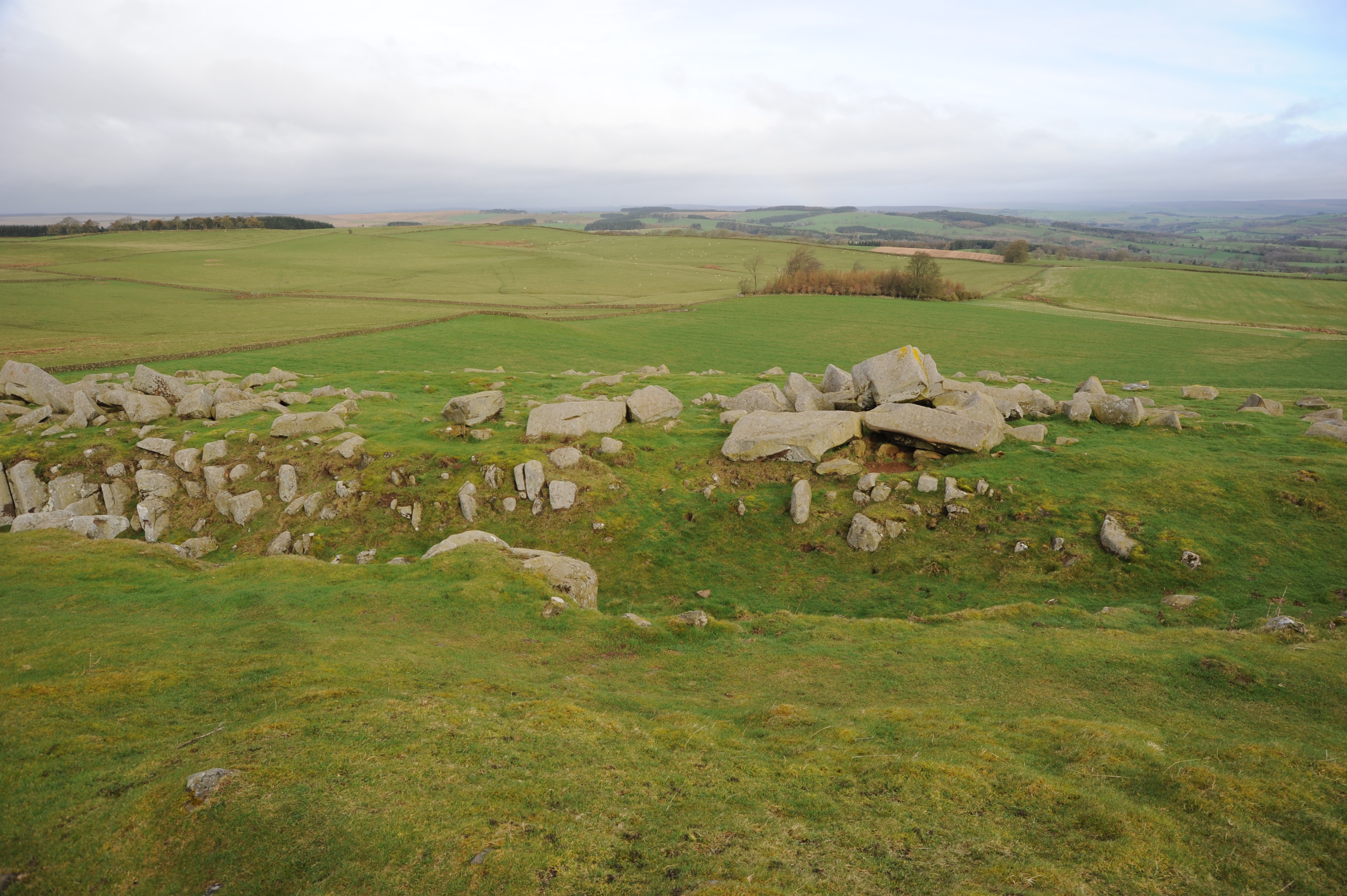
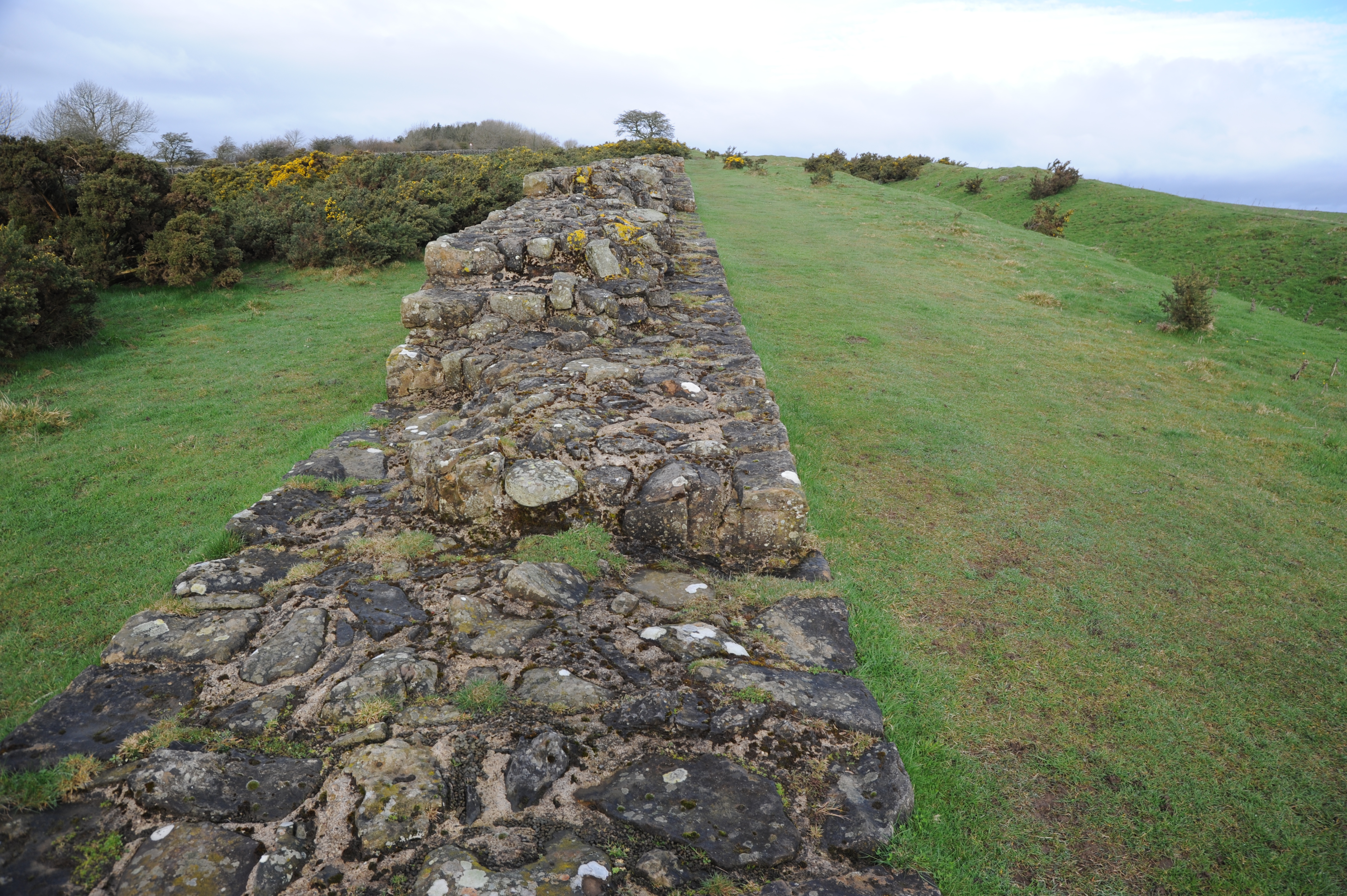
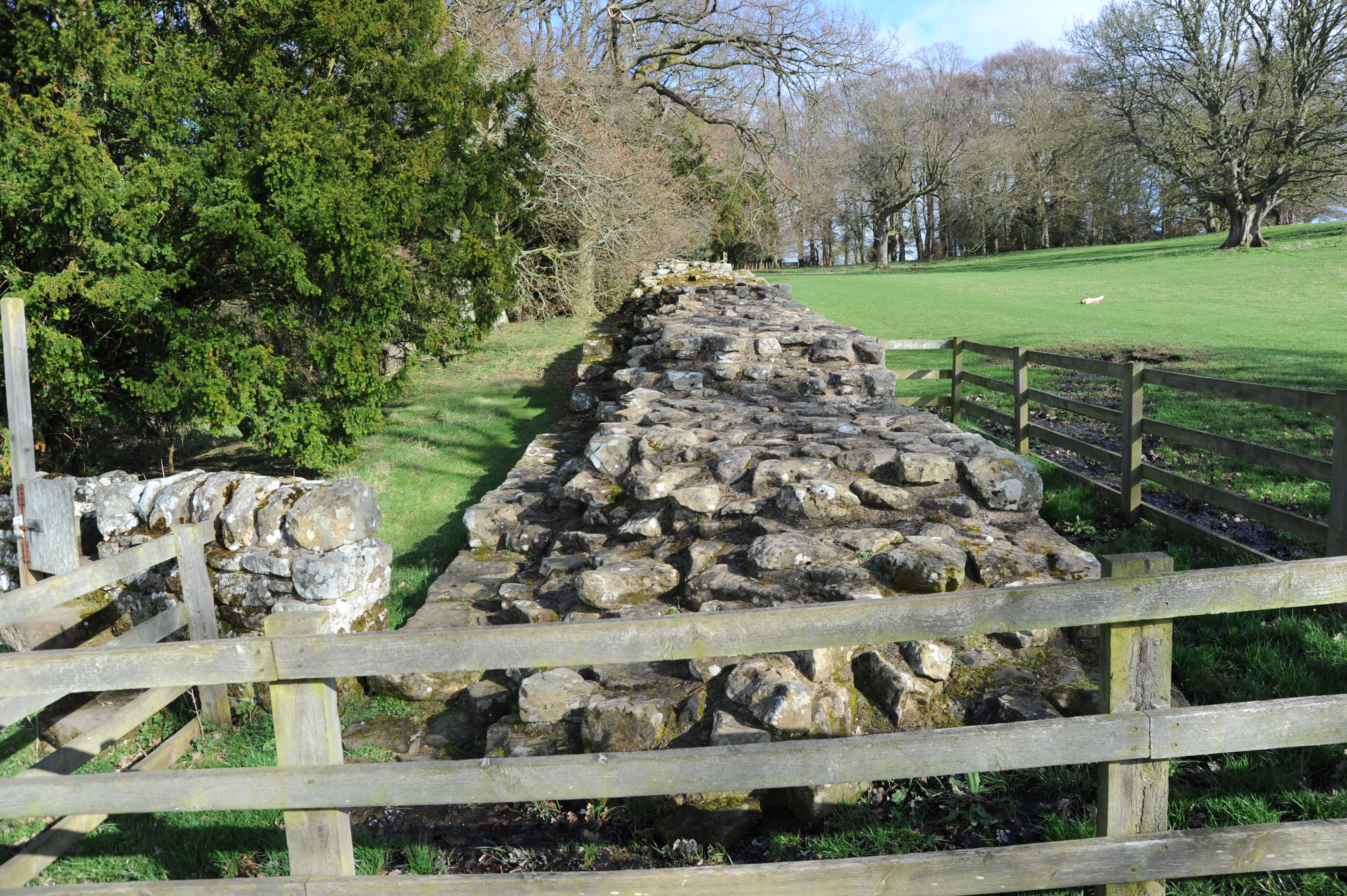
I’ve been moved to circle back to this long-neglected blog by this news story from the BBC, which reports on calls by a local MP to route the easternmost section of the Hadrian’s Wall Path along the actual route of the Wall through Newcastle’s West End. The 84-mile Path is one of sixteen officially designated National Trails, connecting Wallsend in the east to Bowness-on-Solway in the west (which is not the actual end of the Wall’s infrastructure). Currently, the eastern-most section follows the riverside path along the River Tyne through Newcastle’s urban landscape, rather than the actual line of the Wall through the the city’s West End. This is an interesting argument, from the point of view of spatial history and archaeology, and of cultural heritage interaction with historic landscapes – all subjects of professional interest to me.  I also have a personal interest, having walked the whole Path myself in 2011. That’s another reason for this post in fact – I am currently self-isolating with Covid-19, which means I am hankering wistfully after the winds, views and fells of Northumbria even more than normal.

It is also an apt excuse to dig out some of the photos I took on the walk back then:

My guidebook for the walk, Hadrian’s Wall Path, by Henry Steadman (Trailblazer, 2009) wasn’t terribly complimentary about this section. It states it is “not the most auspicious start to the trail”, that it is “hemmed in by warehouses and the back of housing estates, there’s little industry, or indeed anything to see”. It also warns that “one or two trekkers have been subjected to insults and threats from local kids on both this stretch, and the one the leads across Denton Dene”. I have to say this was not my experience at all. On the contrary, I had nothing from cheery greetings from my fellow walkers, including one who noted my backpack and asked if I was going the whole way, and wished me luck.

In the diary I kept of my walk along the Path in 2011, I noted of this section:

Mile after rolling mile of city riverside, and out of town greenfield land do not perhaps quite herald the soaring, monumental fells to come in the way they might. But nonetheless, I think it is good to begin the walk with a cross-section through the modern landscape of the North East, a region built on coal and ships, the ghosts of which may be seen in the derelict and dilapidated steel yards and industrial estates which line the Tyne to the east.

There is indeed a palimpsest of the modern story of Newcastle, stripped for sure of any heritage centre-type gentrification, but hinting at the spatial complexities of a 2000 year-old human-made landscape:

The route itself is a mishmash of river side paths, city Quayside, country footpaths and, in one stretch, the Wylam Waggonway, a dismantled former industrial mini-railway. It makes one think that when we plot ancient networks on maps, how much now-vanished complexity must we be overlooking in the process.

It is not a difficult walk, but the terrain throws you some curveballs as you leave the city:

For the last stretch, the path snakes up through a golf course… the trees are beautiful, all the more so in the dappled sunshine that made it through the hail bursts this afternoon. Shortly thereafter the landscape springs some pretty hairy – and rocky – gradients on you, as the path leaves the river and up towards Heddon-on-the Wall. As if to say “you’ve had it easy for now matey, *this* is a taste of what’s coming”.

Academic scholarship acknowledges that the Wall in the past is also the Wall in the present. As Claire Nesbitt at Divya Tolia-Kelley noted in their 2009 paper:

The Wall is monumental to unravelling narrations of civility, barbarism and imperial strategy, and has resonance with modern accounts of Empire, borders and national identity. It is not just a material for archaeological study, but an organic landscape through which historical, quotidian, geological and affective encounters are made and remembered.

Nesbitt and Tolia-Kelly, 385 [1]

So what do I think of the idea of re-routing the eastern section of the Path away from the Tyne? At first I thought it was a great idea: after all, there is a certain constructivist archaeological purity in routing the official trail along the monument, taking in sections exposed at roadsides and in back gardens. But then I had a better one: keep both routes. This would help stress that the Wall has always been a landscape and not “just” a line. A key part of Nesbitt and Tolia-Kelly’s argument is that the very linearity of the Wall is product of modern imperial perceptions of “inside” and “outside”, “civilized” versus “barbarian”, which did not apply in the northern Roman Empire. This is what the arbitrary line of a National Trail implies (the important arguments about conservation and curation of the monument aside). Keeping both routes would help stress that that landscape is a zone of engagement, not a neat line on a map.

[1] Nesbitt, C. and Tolia-Kelly, D., 2009. Hadrian’s Wall: Embodied archaeologies of the linear monument. Journal of Social Archaeology, 9(3), pp.368-390.

Another corpse path (Plush, Dorset)

This is a much delayed (and very brief) write up of another corpse path, one we walked late last summer (between lockdown restrictions) in Dorset. This one links the village of Plush, near Dorchester, with the thirteenth century Church of the Holy Rood in Buckland Newton, about three miles to the north west. It features on my little database of corpse paths, being mentioned in Deveraux’s anthology.

Holloway leading up West Hill

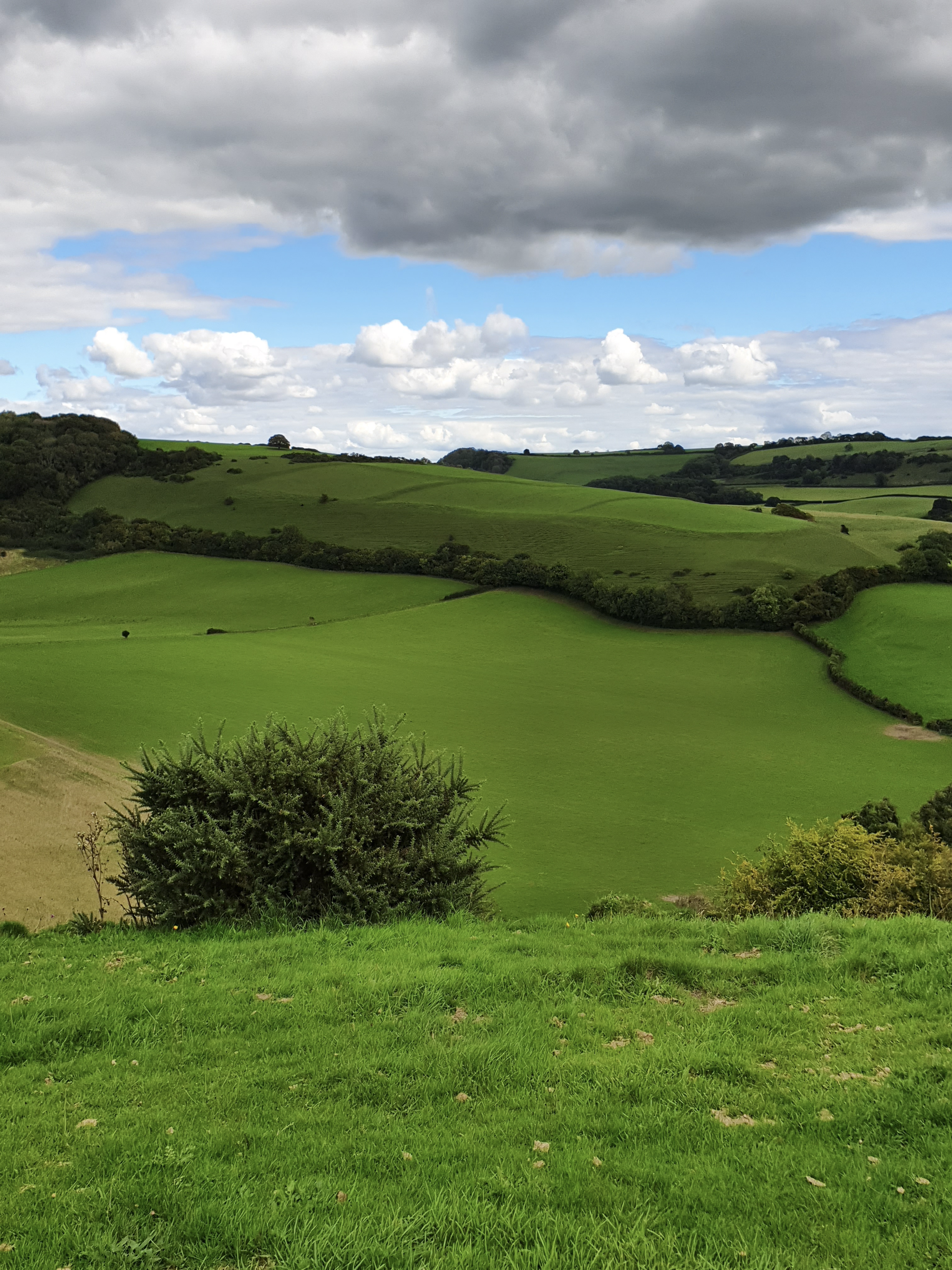
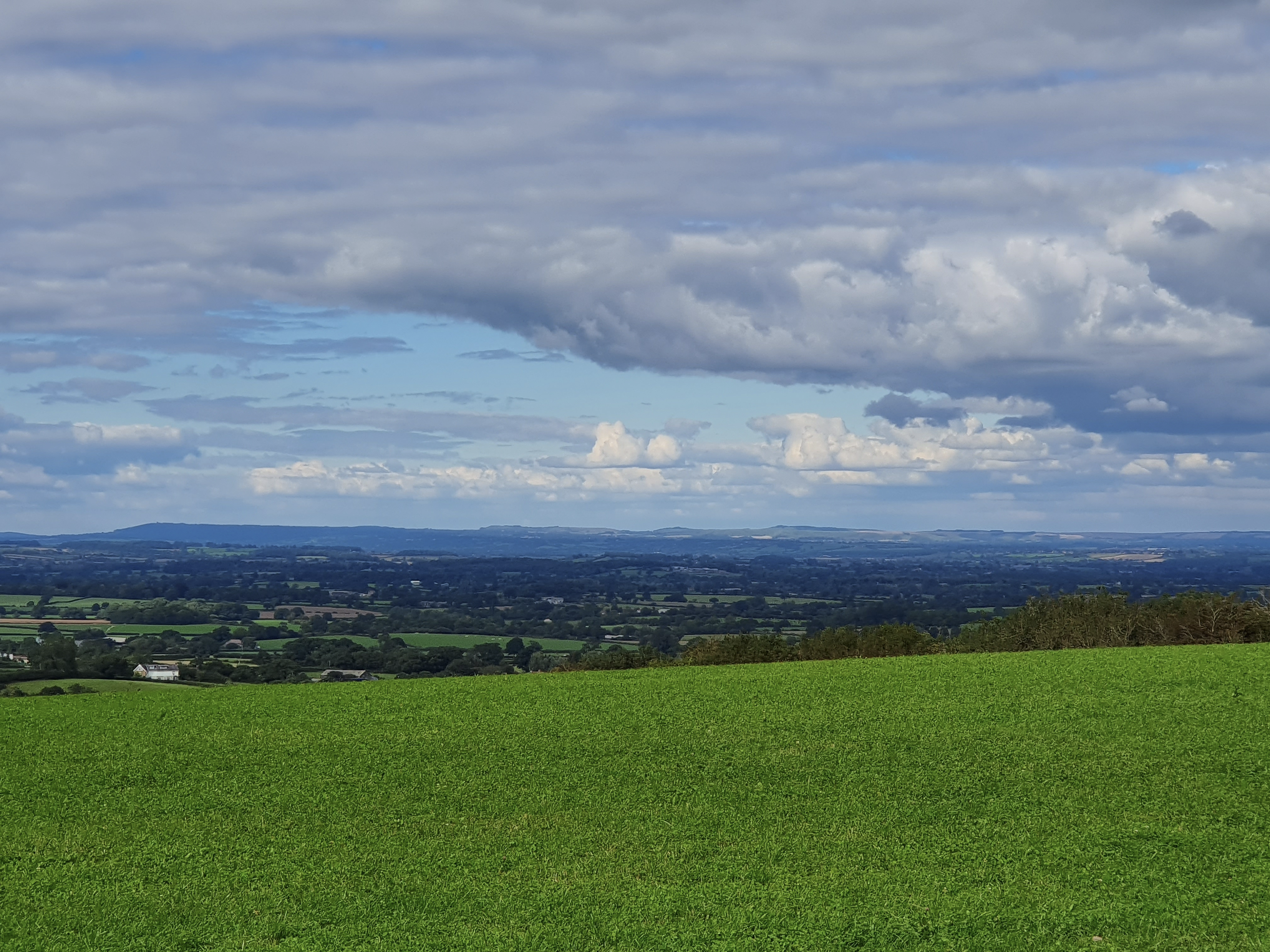
The path starts as a satisfyingly deep holloway, branching off from the road into Plush, and tracing a steepish path north, up the side of the West Hill towards Watcombe Plain. Opening out, and affording stunning views of field systems (Iron Age, I think) on the eastern side of the valley, the path follows the contours of the hill round to the west. Crossing White Way, it becomes Crowthorne Lane as it makes its descent towards Buckland, and then Hilling Lane.

Iron Age(?) field systems viewed from Watcombe Plain

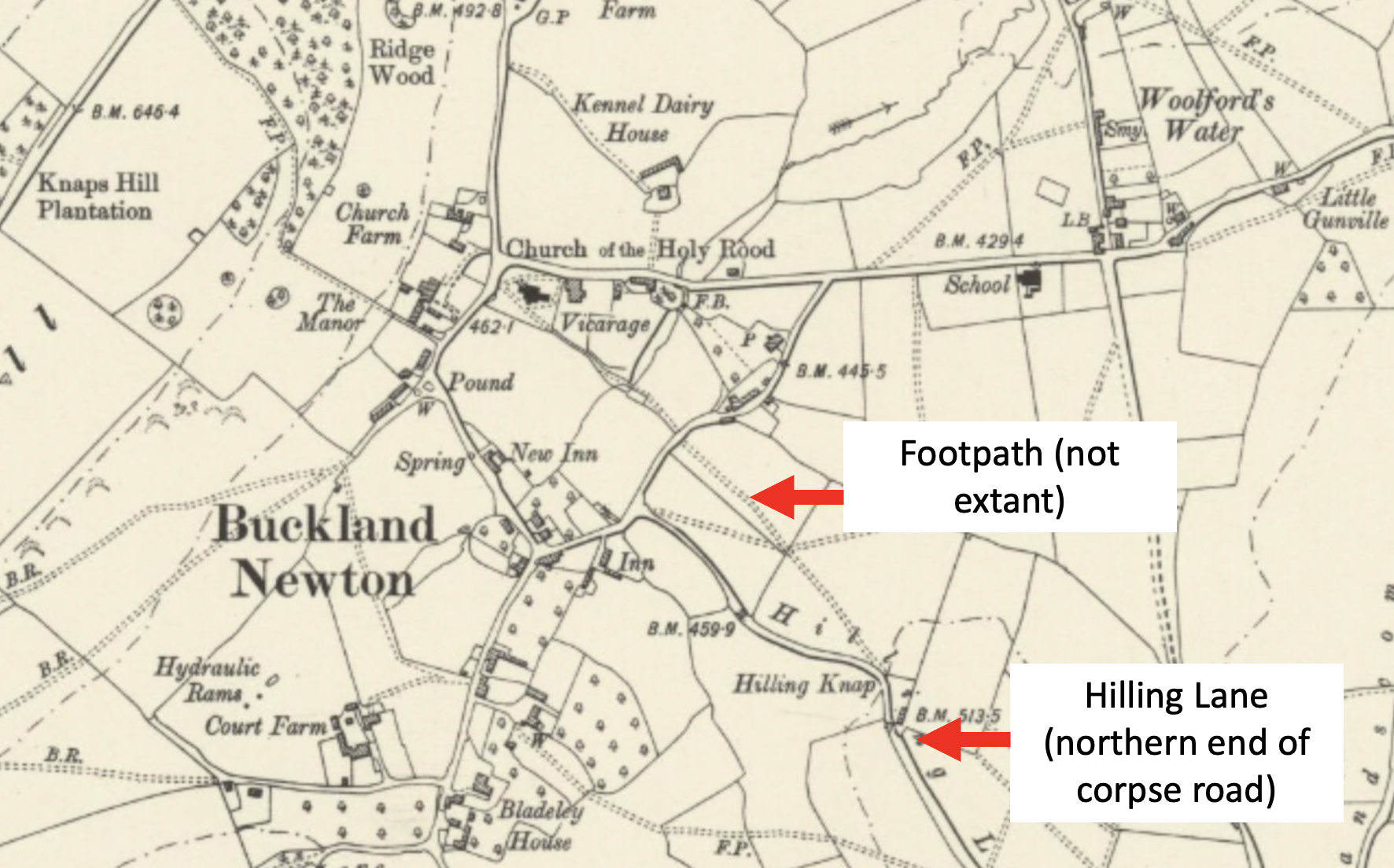
As Hilling Lane enters Buckland itself, it branches south, away from the church. There appears to be no extant footpath or right of way linking this section with the church itself, but in one of those pleasing bits of historical jigsaw-fitting that occasionally comes along with these things, such a footpath clearly appears on the 1903 Ordnance Survey map (which marks much of the rest of the route as B.R., = Bridle Route); following the trajectory of Hilling Lane straight to the church.

Ordnance Survey Dorset XXII.SE (1903)


Church of the Holy Rood, Buckland Newton

Paths, desire lines and Covid-19: some observations (and pictures)

“Desire lines”, or “desire paths” are, at one level, a relatively straightforward concept in the fields of planning, land management and architecture. The Wikipedia definition will serve:

[A] path created as a consequence of erosion caused by human or animal foot traffic. The path usually represents the shortest or most easily navigated route between an origin and destination. The width and severity of erosion are often indicators of the traffic level that a path receives. Desire paths emerge as shortcuts where constructed paths take a circuitous route, have gaps, or are non-existent.

However, the idea of the “desire path” becomes more complex when some of the concepts and assumptions in this definition are unpacked. How are “constructed paths” constructed? By whose authority? What motivators, apart from ease of access or shortness of route, define the course of a desire path? The idea of the desire path, as framed here, would encompass “holloways”, described by the writer Robert Macfarlane, Stanley Donwood and Dan Richards, in their book of that name, as “a hollow way, a sunken path. A route that centuries of foot-fall, hoof-hit, wheel roll & rain-run have harrowed deep down into bedrock”: how can we unpick the complex network of historical and archaeological drivers which shaped them over hundreds of years?

Desire paths are intimately linked with the fundamental motivators which govern human interaction with space and place, and they can be intensely political. A significant aspect of the Paris Situationist philosophy, for example, was resistance to the constructed path, and to the bourgeoise banality of the planned urban space. The term “Vox Populi, Vox Dei”; the voice of the people as a kind of collective wisdom, funnelled by a kind of collective interpretation of the moral, cultural or political angle of a particular issue, and equating the voice of God, is a well-worn political trope dating from at least the early eighteenth century, probably a lot earlier. Might there be a similar trope for the “walkings of the people”? “Ambulari Populi” perhaps?

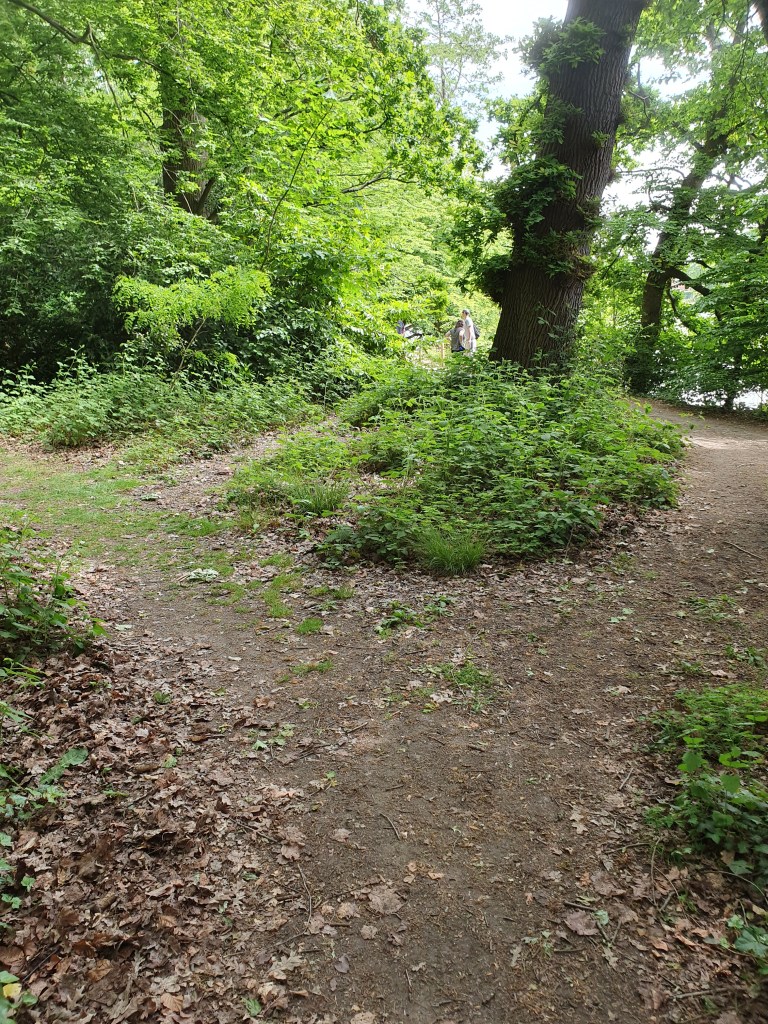
The ambulari populi changes pathways, whether constructed or not. In the example below, a tree has been effectively subsumed by a path as walkers have increasingly used both, rather than just one side of it:

Whiteknights Lake, Reading, 17th May 2020.

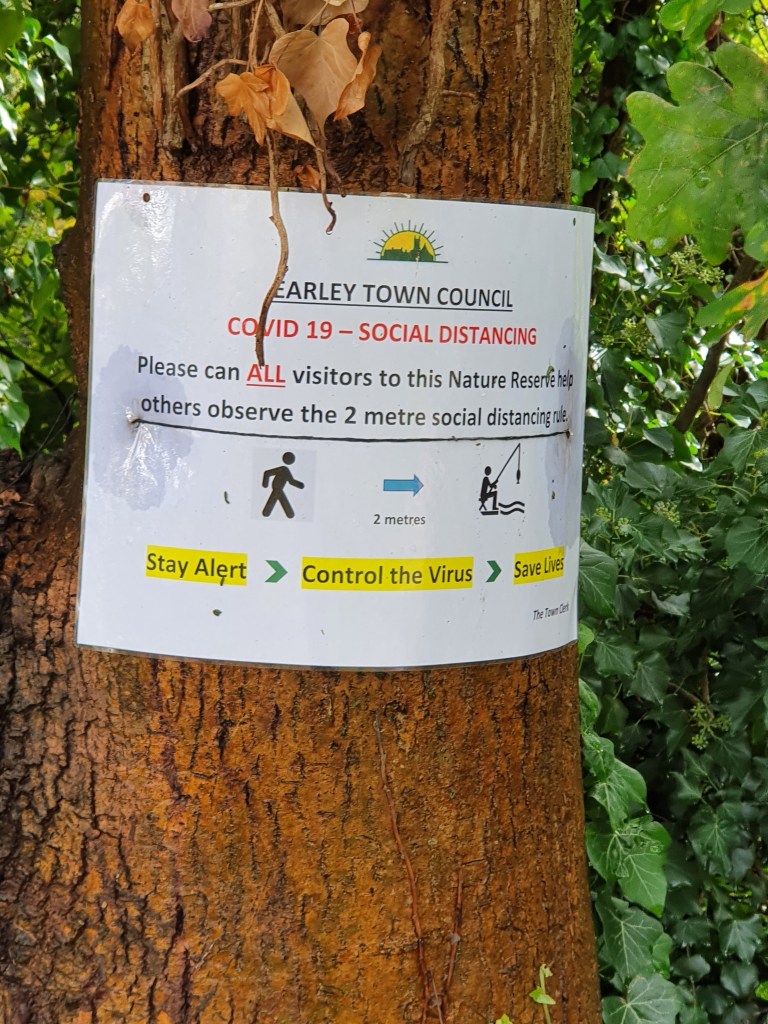
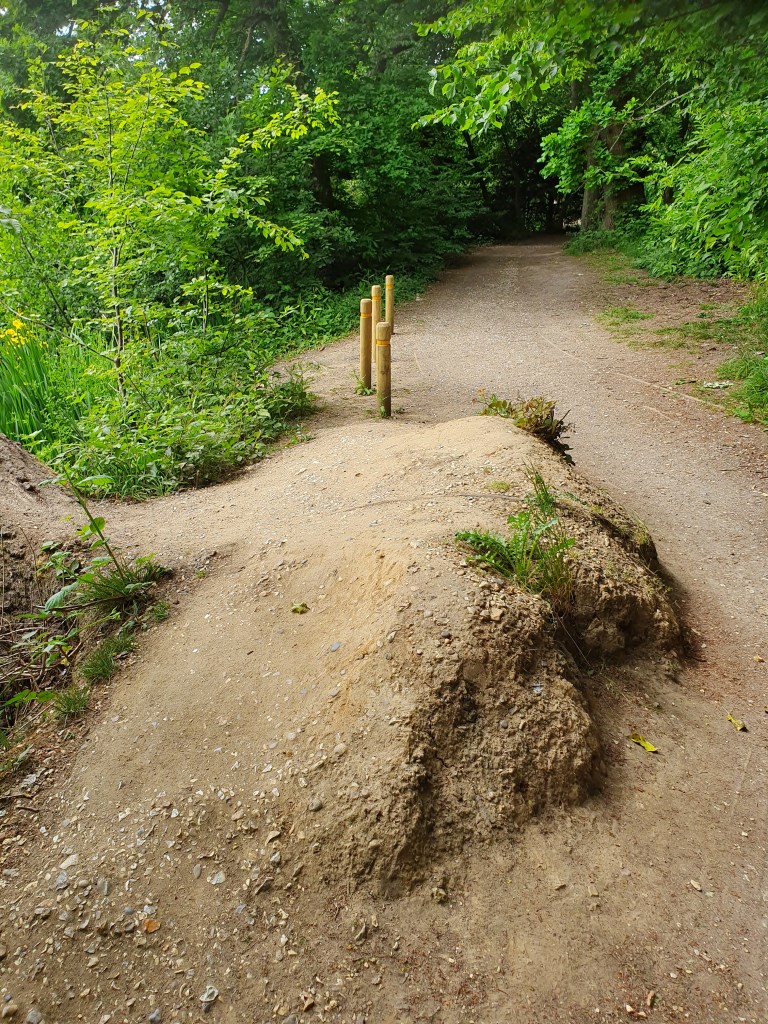
There are some big concepts here, but – as Macfarlane et al and others have observed – they are visible in the day to day. I offer here a small, literally pedestrian observation gleaned from 2020’s months of Covid-19 lockdown.  Many of the desire paths we created, and continue to create, have undergone a subtle transformation, as a result of social distancing. The idea of the path has been rethought, as people internalized the need to keep two meters apart to prevent the spread of infection. Our behaviours have changed: when, on path – whether constructed or not – two or more of us approach from opposite directions, the instinct has become to maximize the distance between us as we pass, treading the very outer edge of the path as we do so – and, in some cases subtly altering it.

Earley Lake, Reading, 3rd October 2020

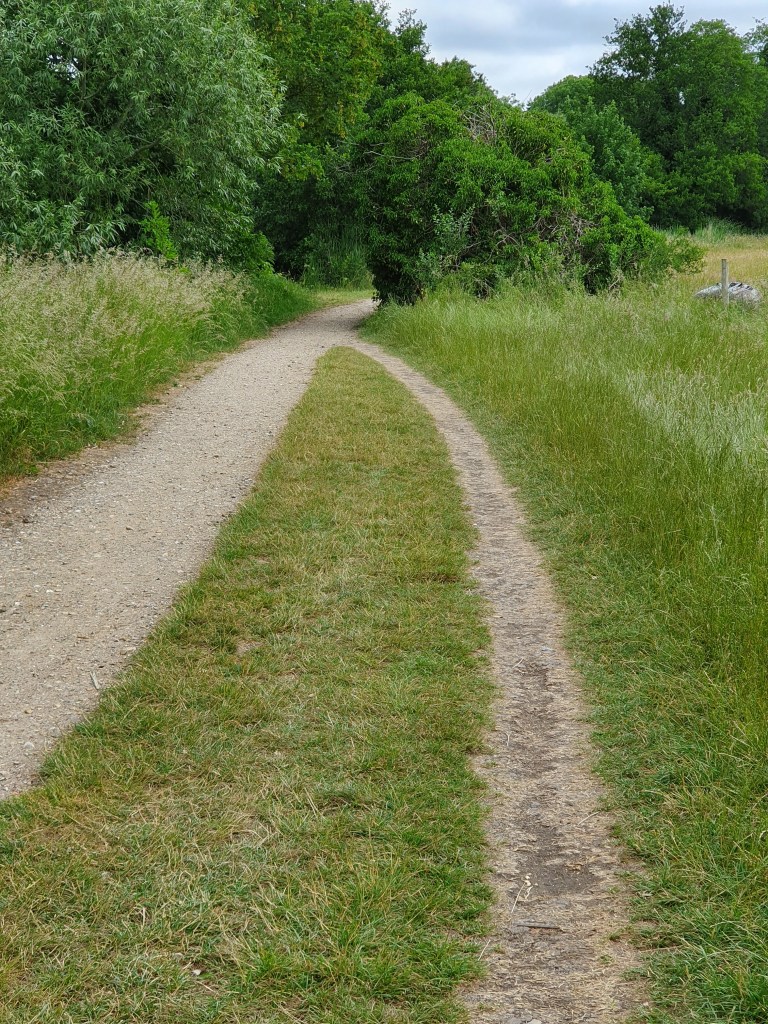
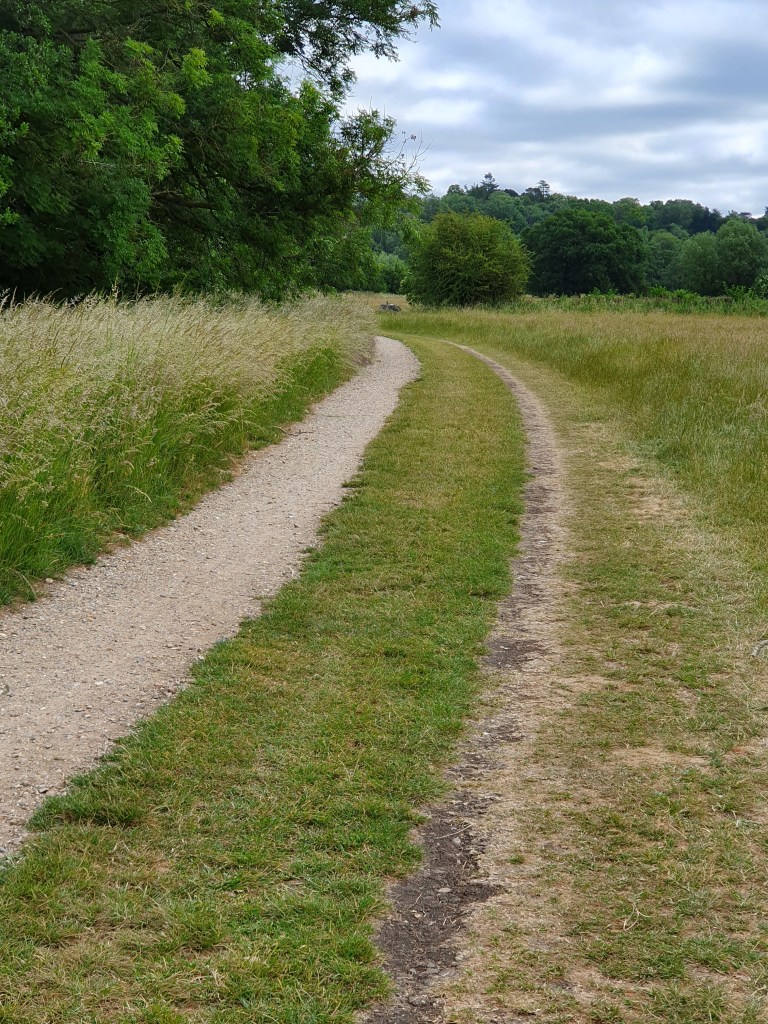
Since April or thereabouts, I have been documenting the way “Covid desire lines” have come to express the desire to socially distance in the fabric of the landscape, and how paths have developed as a result (many of these pictures date from the height of the national UK lockdown, and I hasten to add at this point that they were all taken during my permitted once-daily exercise).

In some cases, as below, where there is an existing track of some breadth, “sub-paths” develop on the opposite sides, as walkers use the width of the path to avoid one another.

Near Sindlesham, Berkshire, 17th April 2020.

In others, the new desire lines have strong relationships with field boundaries. In the very clear example below, clear distance is maintained between the pre-existing path on the left and the new one on the right, until they are compressed together by the gap in the fence.

Thames tow path, Berkshire, 8th June 2020

However, in the stretches where we have the freedom to socially distance without constraint, the evenness of the old and new paths, and the spacing between them, is striking:

Thames tow path, Berkshire, 8th June 2020

Desire paths can be very persistent, and where imperatives such as social distancing are in play, they bely the simple notion that the physically easiest or shortest route must always prevail. Here the bole of a fallen tree is overrun by those socially distancing towards the left:

Whiteknights Lake, Reading, 17th May 2020

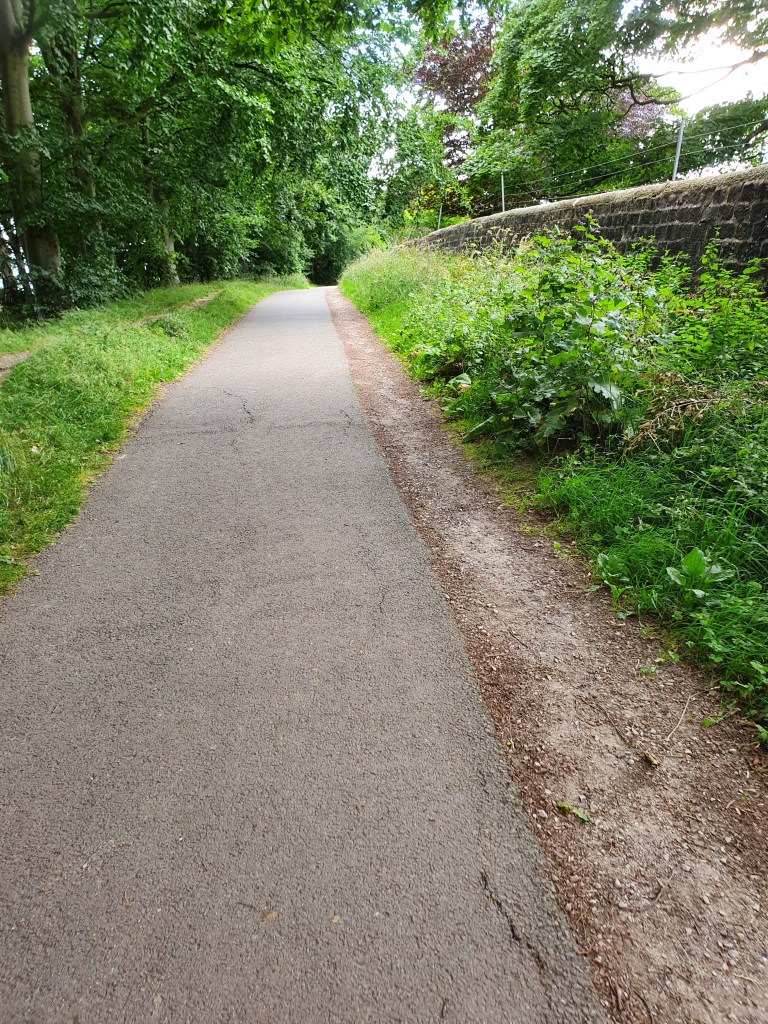
In other cases, they append themselves to metaled paths:

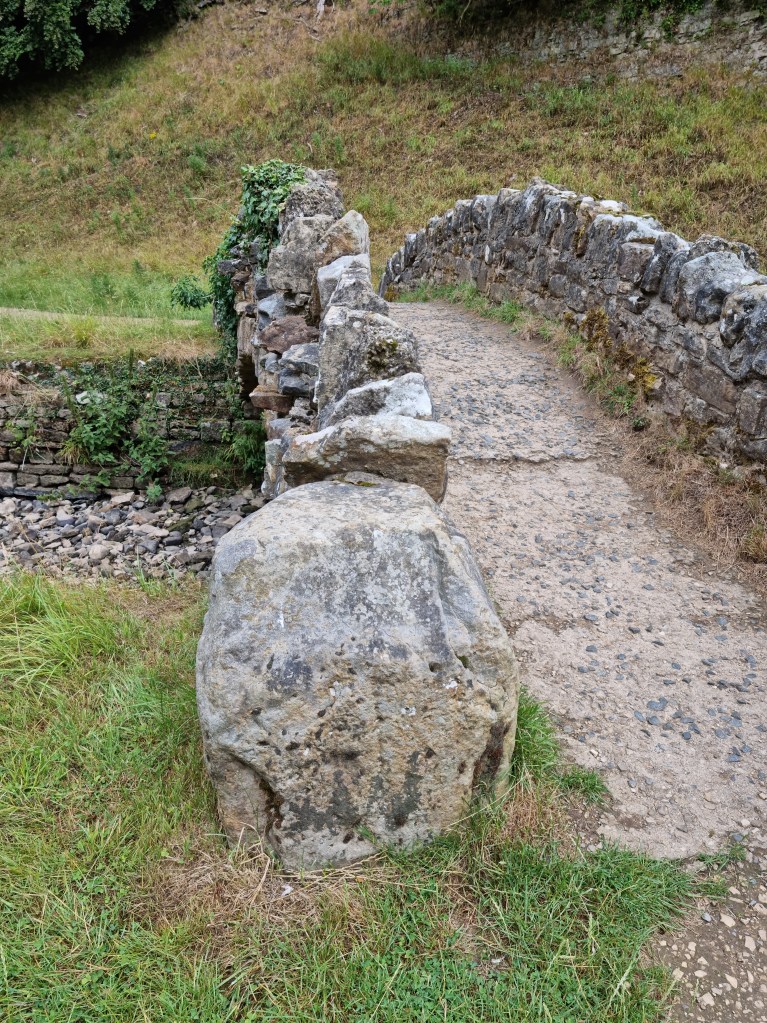
Ripley, Yorkshire, 22nd July 2020

There is no real conclusion to draw here, beyond that even surface-level desire paths such as these, imposed only on the very top layer of the landscape by a few weeks of extra-ordinary measures, have different facets, and represent different responses at places where our relationship with the landscape is constrained in different ways. Cost-path reductivness in GIS is all well and good, but it must always be qualified by many, many layers of human interpretation.